
Author name: Erion Shehaj

I help professionals achieve financial freedom through real estate so they can live life on their terms. The ideas I write about come from my 20+ years of experience as a real estate broker, investor, and guide. I’ve helped clients purchase over $300 million in real estate assets to build their wealth. More importantly, I’ve been through different economic cycles and watched patterns emerge. I know what works and what doesn’t for busy professionals with demanding careers. I consider it my job to cut through the noise, eliminate the overwhelming options, and present you with a clear, proven path forward. Too many successful people never achieve financial freedom because they’re paralyzed by options or chasing the next shiny strategy. I am originally from Albania, a rugged country on the Mediterranean sea in southern Europe. I came to the US as an exchange student in 1999 and was the first member of my family to go to college. I believe that we best appreciate opportunities by way of contrast. Growing up in a totalitarian and communist country was not easy – but it has also provided me with a unique perspective that I utilize to spot opportunities and help my clients apply to reach financial freedom. My work isn’t about get-rich-quick schemes or building “empires” that become second jobs. It’s about using real estate as a tool to engineer the life you truly want—where work becomes optional, time belongs to you, and your finances support your values rather than dictate your choices.

How the Hidden Superpowers in Your Biggest Disadvantages Become Your Competitive Edge

The Lies We Tell Ourselves About Success

We’ve all heard the mantras: “Your network is your net worth.” “It takes money to make money.” These statements carry an insidious implication that if you don’t already have established networks or significant capital, you might as well give up before you start.

I see these limiting beliefs constantly among successful professionals who want to build real estate portfolios. They earn six-figure salaries but convince themselves they have permanent real estate investing disadvantages because they didn’t start investing earlier or don’t have access to the best opportunities or as much investment capital as some of their luckier peers. They assume the game is rigged against them. And if the game is rigged, what’s the point of even trying.

My own story is proof that this is not true. So I’d like to share it with you in hopes that it helps you.

Starting from Zero

I arrived in the United States as a 17-year-old high school student from Albania. At the time, my country was one of the poorest in the world. We came from 45 years of a totalitarian communist system not unlike North Korea, where the state owned everything and private property was prohibited by law.

I had no network, no money, I literally had no idea what real estate was or how it worked at the most basic level. I went to college to study accounting and finance with every intention of getting a corporate job and start climbing the ladder.…

How the Hidden Superpowers in Your Biggest Disadvantages Become Your Competitive Edge Read Post »


real estate porfolio management

The System I Use To Decide Which Properties To Keep Or Trade In My Real Estate Portfolio

real estate porfolio management

Most real estate advice focuses on finding and funding your next acquisition. While that’s important, it’s not what makes the difference in the long run. Instead, the most important strategic decision a savvy investor has to make is which of the investment properties they already own they should keep, reposition, or trade. This creates a fundamental problem in wealth building. Your portfolio is only as strong as its weakest properties. Most investors lack a system and a framework for real estate portfolio management to help them identify which properties those are. They hold onto underperformers for years, sometimes decades, while better opportunities pass them by. They make emotional decisions based on gut feelings and short term market fluctuations rather than empirical data.

Picture this scenario: You’re sitting across from me in my office, and I ask you to rank your properties from best to worst performing. You pause, mention cash flow numbers, then start talking about that “problem property” you’ve been meaning to deal with. When I press for specifics about why you would sell one property versus another, the conversation becomes vague. You mention gut feelings, talk about that one tenant who calls too much, or describe a neighborhood that “doesn’t feel the same anymore.”

This happens constantly. Successful professionals who earn six-figure incomes and make complex decisions at work every day rely on emotions and hunches when it comes to their real estate portfolios. They treat their investment properties like family heirlooms rather than business assets, holding onto them regardless of performance.…

The System I Use To Decide Which Properties To Keep Or Trade In My Real Estate Portfolio Read Post »

how to build a real estate portfolio that serves your life

How to Build a Real Estate Portfolio That Serves Your Life: The Tenant-First Investment Strategy

how to build a real estate portfolio that serves your life

Most real estate investors have it backwards. They obsess over metrics while building portfolios that bring frustration and slowly consume their lives. They chase the highest projected cash-on-cash returns only to end up with properties they secretly wish they’d never bought. The end result? A collection of underperforming investments that don’t deliver on expected returns but deliver a miserable ownership experience. 

Just last week, I was reviewing an investment property with a client. I pointed out  the fundamentals that made the property a great investment: great location, excellent schools, strong tenant demand, population growth and more. He kept circling back to a single question: “But what’s the cash-on-cash return?” 

This wasn’t the first time I’d witnessed an investor hyper-focused on a single metric while losing sight of the bigger picture. It’s a common trap. Viewing real estate exclusively as an ATM machine whose sole purpose is to generate the highest monthly cashflow possible at any cost.

Don’t get me wrong. Metrics matter. But when you optimize solely for numbers on a spreadsheet, you often end up with a portfolio that looks impressive on paper yet creates an ownership experience you never wanted. Think prolonged vacancy, high turnover rate and costs, underperforming rents and properties in locations you’d rather not visit after dark.

There’s a different way. 

The Asset Focused Trap

This investing philosophy leads not only to great financial outcomes but also a great ownership experience. It’s a  mindset shift that changes everything. How you build a real estate portfolio, how you select properties, how you manage them, and most importantly, how they fit into the life you actually want to live. …

How to Build a Real Estate Portfolio That Serves Your Life: The Tenant-First Investment Strategy Read Post »

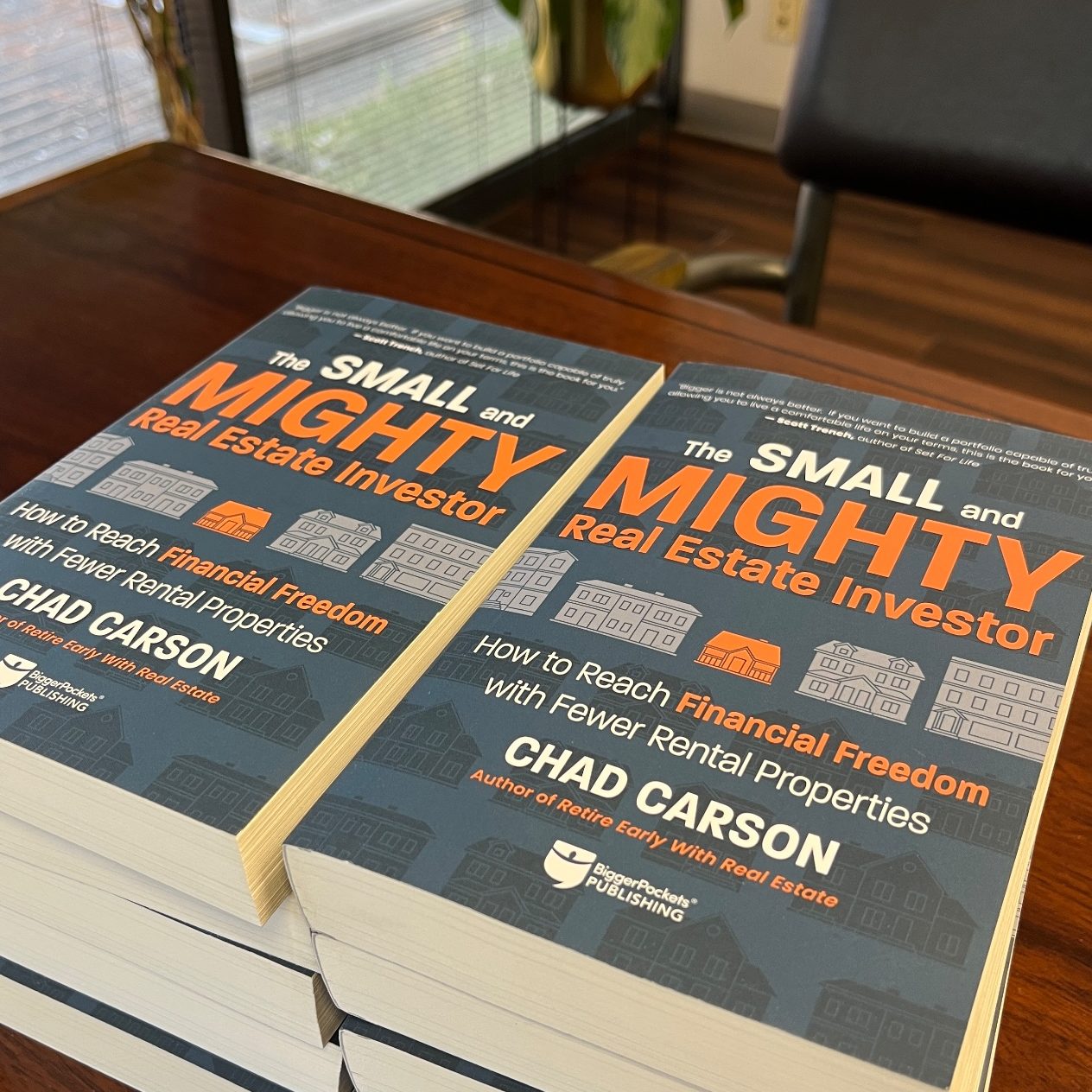
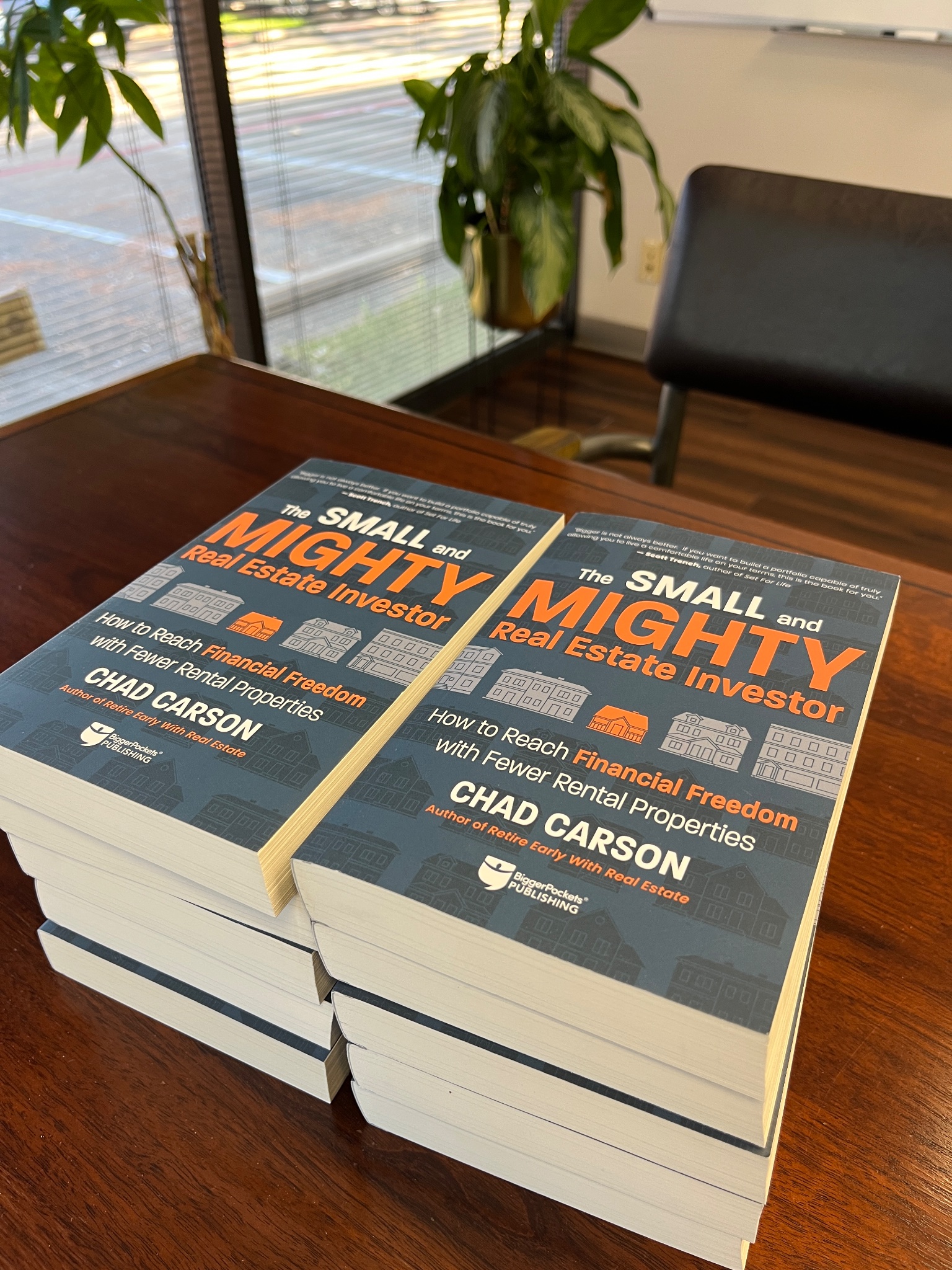
The Small and Mighty Real Estate Investor Book Review: Simplify Your Portfolio and Win

Finally … a real estate investing book that doesn’t ramble on about 10x and “building empires” (whatever that means)!

I had the pleasure to receive a copy of Chad Carson’s new book: The Small and Mighty Real Estate Investor before it came out. As soon as I read it, I immediately recognized that it was an important message that needed to be heard. Now, the book is available on Amazon, Bigger Pockets and Audible.

Why Read the Small and Mighty Real Estate Investor?

You know that feeling when you believe something deep down but you can’t articulate it into words?

And then you read a book that expresses that same belief in plain English and it resonates with you immediately? That’s what the first part of The Small and Mighty Real Estate Investor was for me.

There are many reasons why you should read this book. Different reasons might appeal to different investors depending on where you are in your investing journey.

But for me, the principal reason to read this book is the crucial shift in mindset that it offers right out of the gate.

In Part 1 of the book, Chad Carson comes out swinging with The Small and Mighty Manifesto. It’s the constitution for the real estate investor that prioritizes their freedom over money or ego metrics like number of doors owed. This section of the book validates the belief that so many investors like us hold that your real estate portfolio should serve the life you want to live and not the other way around.…

The Small and Mighty Real Estate Investor Book Review: Simplify Your Portfolio and Win Read Post »

The BIG Mistake I See Investors Make When Selecting Out-of-State Real Estate Markets

On one hand, you want to invest in real estate to build a solid portfolio and achieve financial independence. On the other, you are currently located in a market where real estate is too expensive to make the numbers work.

What do you do? The obvious and easy solution is to consider investing opportunities in out-of-state markets where prices and rents are much more balanced. But the ease quickly ends when you have to get tactical and select a good market to invest in.

This is the point where I see real estate investors make the BIG Mistake: They rely on “Best Real Estate Markets to invest in 2020” articles to select their target market. I can certainly understand the allure. The research criteria for selecting these markets seems rigorous. They are looking at population and job growth plus real estate price and rents growth. What’s more, they offer a “silver bullet” that reduces the overwhelming task of picking from a multitude of options into a few neat bullet points.

“Why is that the wrong methodology to select a real estate market”, you ask?

One major reason: All the data they’re using to select the target market is backward-facing which means that it only tells you what has already happened. It is telling you that it was great to invest in that market 5 years ago. Investing in a real estate market because of its performance in the past is like deciding to invest in Apple stock because it is up huge over the last 5 years.…

The BIG Mistake I See Investors Make When Selecting Out-of-State Real Estate Markets Read Post »

My first podcast interview on Real Estate Investing with Coach Carson

Last week I had the great pleasure to be a guest on Coach Carson’s Real Estate & Financial Independence podcast. For those of you that may not know him, Chad is the author of Retire Early with Real Estate and The Small and Mighty Real Estate Investor, a fellow contributor to the BiggerPockets Blog (where we met), a great friend and above a true stand up guy in the real estate investment space.

We often have deep dive conversations about real estate investing where we “nerd out” on strategies and tactics to best achieve financial independence goals. This time we decided to record one of our conversations for the podcast.

We cover a wide range of topics from the main challenges that investors face to the process for putting together an investment strategy, to nuts and bolts tactics of how to get it done.

I hope you enjoy it as much as I did.

Listen on Apple Podcasts: https://podcasts.apple.com/podcast/id1448707654
Listen on Overcast: https://overcast.fm/+QHV1_jZds

My first podcast interview on Real Estate Investing with Coach Carson Read Post »

The main reason why some investors succeed with real estate investing (and others fall short)

I want to share with you a tale of two investors. Picture two childhood friends who went to and graduated from the same college with a degree in the same field. They possess the same natural talents and intelligence. Further still, they earn the same income and live the same lifestyle which results in the same savings rate and same amount of investment capital.

Fast forward a decade or two. One of these investors goes on to build an impressive real estate portfolio with multiple streams of income at different stages of her life. Meanwhile, the other does some sporadic investing and ends up with a couple rental properties that while they provide a good return on investment don’t change his life in a meaningful way.

Key Question: What made the difference?

If all the ingredients are the same, what was the cause of such vastly different results in the end? Why did one investor manage to succeed at a much higher level while the other fell short?

While the above is a hypothetical scenario meant to isolate the critical difference maker in success for long term real estate investors, I can tell you that in my experience I’ve seen similar scenarios often. Based on that experience, I can tell you that the critical factor that separates successful investors from those that fall short is the presence of a thoughtful strategy and the execution of a plan of action that flows from that strategy.

Why successful investors need a strategy to succeed?

The main reason why some investors succeed with real estate investing (and others fall short) Read Post »

How many properties can a real estate investor self-manage?

Most investors who ask this question are looking for a “Rule of Thumb” type of answer. For instance: Up to X number of properties you can manage yourself, any more and you need professional property management. But, that’s too simplistic an answer.

In my experience, I’ve seen individual investors manage 15-20 rental properties on their own with ease as well as investors who lost their mind after managing two problematic rentals.

There are too many factors at play to give a one size fits all answer. But if I had to reduce it down to the essential, the answer depends on four major factors.

Where does the investor fit in the Convenience – Savings continuum?

Picture a continuum where on the far left you have maximum convenience and on the far right you have cost savings. Where do you fit within that continuum? Are you the type of investor that wants or needs to be completely hands-off? Perhaps you have a demanding profession that doesn’t allow the bandwidth to deal with a rental property. Or simply, you are looking for an investment that’s as passive as possible. If this is you, the answer has been already answered for you. The maximum number of properties you can self-manage is zero. The best option in your case is find and vet a good property management company and let them handle the day to day. You will pay them a fee in return for the convenience but since convenience is paramount, the fee is worth it.…

How many properties can a real estate investor self-manage? Read Post »

How to maximize returns in your stock market and 401(K) investments

https://youtu.be/nouSkGNRL5Y

When I posted a video on how to decide if you should pay off debt or invest earlier this week, a friend (and past client) commented with the following question:

What’s the best way to maximize the returns on investment for your stock market and 401(K) investments?

The answer may surprise you.

First let’s consider the following facts:

Over a 10 year investment timeframe 85% of mutual funds underperform the market. Extend the timeframe to 15 years and 92% of mutual funds underperform the market. In a nutshell, the overwhelming majority of funds underperform the market over the long run and charge you higher fees for that privilege.

But before you say: “You’re saying there’s still a chance …” you have the understand that the 8% that do outperform are not always the same funds. Meaning, a fund could outperform this year but underperform the next.

At this point I want to share one of my favorite quotes ever from Warren Buffett’s long time partner, Charlie Munger:

It is remarkable how much long-term advantage people like us have gotten by trying to be consistently not stupid, instead of trying to be very intelligent.

That idea is as profound as it is clever. Most “wounds” in the financial realm are self-inflicted. How else can you explain the fact that while the market averages 10% returns over a period of time, investors average 4%.

So what should you do instead? Focus on what you can control: Costs and not doing anything stupid!…

How to maximize returns in your stock market and 401(K) investments Read Post »

Are you a real estate investor that suffers from Cash Flow Tunnel Vision?

Cash flow tunnel vision is a common and dangerous blind spot among real estate investors who “worship at the altar of the cashflow” (as my good friend Jeff Brown would say).

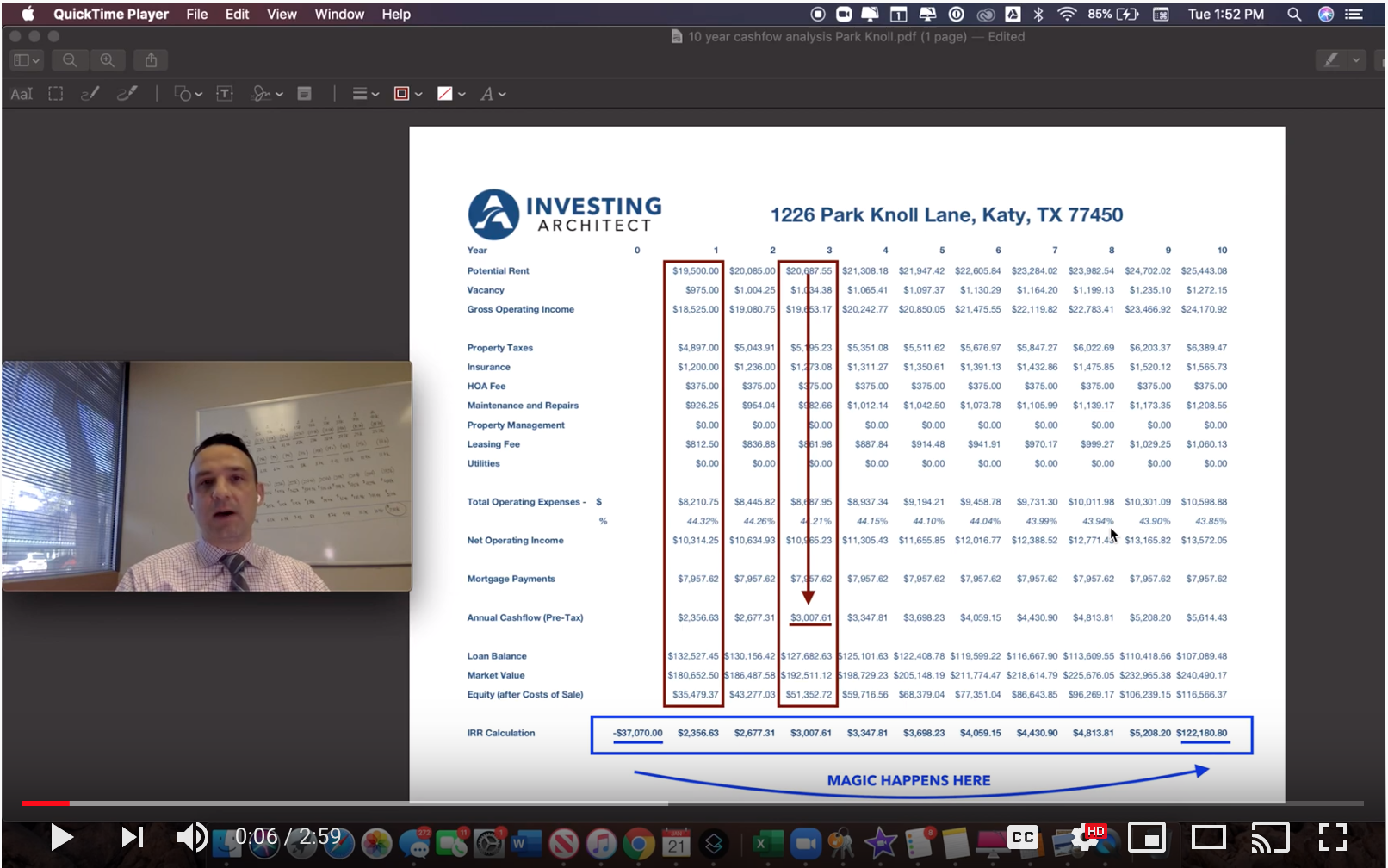
It’s a tendency to ONLY pay attention at the cash flow produced by the property on an annual basis. For instance, an investor will run the Year 1 numbers on a rental property to calculate the cashflow for the year. Rent minus expenses minus mortgage payment equals cashflow. Then they divide the cashflow into the amount invested in the deal and calculate the cash on cash return. This return is then compared to an arbitrary return benchmark and a decision made.

Cash flow is nice, don’t get me wrong. But cash flow is not where the MAGIC happens in real estate.

The MAGIC is in the long game: Where you invest $37,000 into a rental property and net 3.3x that amount 10 years later.

The cashflow is the dividend you get every year and it makes you some money. But the growth over time is what makes you a fortune.

Are you a real estate investor that suffers from Cash Flow Tunnel Vision? Read Post »

Scroll to Top
Subscribe to articles

The Playbook for Financial Freedom

Delivered Weekly in your inbox